Introduction
The foreign exchange (Forex) market is the world’s largest financial market, with trillions of dollars traded every day. While Forex trading offers opportunities to profit from currency price movements, it also involves significant risk. Successful traders rely on well-tested strategies, disciplined risk management, and continuous learning rather than speculation.
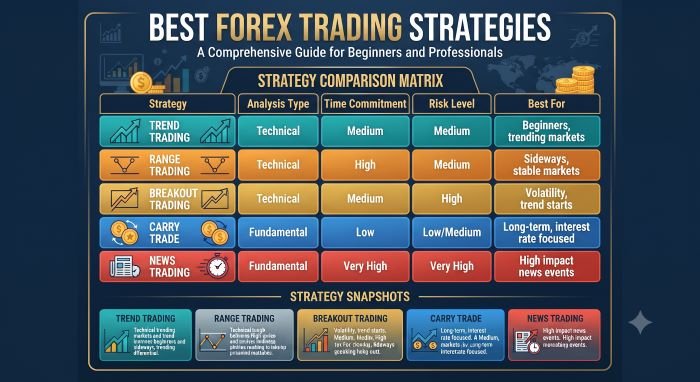
Whether you’re new to Forex or looking to refine your trading approach, this guide explains some of the most effective Forex trading strategies used in 2026. You’ll also learn how to manage risk, understand market trends, and combine technical and fundamental analysis to make more informed trading decisions.
Important: Forex trading carries a high level of risk and is not suitable for every investor. Past performance does not guarantee future results.
Understanding Forex Trading
Forex trading involves buying one currency while simultaneously selling another. Currencies are traded in pairs, such as:
- EUR/USD
- GBP/USD
- USD/JPY
- AUD/USD
- USD/CAD
Prices move based on economic data, interest rates, geopolitical events, and overall market sentiment.
Trend Following Strategy
Trend following is one of the most popular Forex trading strategies because it focuses on trading in the direction of the overall market trend.
Instead of trying to predict market reversals, traders attempt to identify and follow established trends.
Popular Trend Indicators
Many traders use technical indicators such as:
- 50-day Simple Moving Average (SMA)
- 200-day Simple Moving Average (SMA)
- Relative Strength Index (RSI)
- Moving Average Convergence Divergence (MACD)
Tips
- Trade with the overall trend.
- Wait for pullbacks before entering.
- Confirm signals with multiple indicators.
- Avoid trading against strong market momentum.
Price Action Trading
Price action trading focuses on analyzing price movements without relying heavily on technical indicators.
Traders study candlestick patterns, support and resistance levels, and market structure to identify potential trading opportunities.
Common Price Action Signals
- Pin bars
- Engulfing candles
- Inside bars
- Breakouts
- False breakouts
Support and resistance zones often play an important role when planning trade entries and exits.
Risk Management
Risk management is one of the most important aspects of successful Forex trading.
Even experienced traders experience losing trades. The goal is to protect your trading capital while allowing profitable strategies to perform over time.
Best Risk Management Practices
- Risk only 1–2% of your account on a single trade.
- Always use stop-loss orders.
- Maintain realistic risk-to-reward ratios.
- Avoid emotional trading.
- Never increase position size to recover losses.
Proper risk management often has a greater impact on long-term success than choosing the perfect strategy.
Position Sizing
Your position size should match your account balance and market volatility.
For example:
- Trading Account: $10,000
- Maximum Risk Per Trade (1%): $100
Position sizing helps prevent a series of losing trades from causing significant damage to your trading account.
Algorithmic Forex Trading
Technology continues to transform Forex trading.
Algorithmic trading uses computer programs to execute trades based on predefined rules rather than emotions.
Many trading platforms now provide tools that allow traders to:
- Build automated strategies
- Backtest trading systems
- Analyze historical performance
- Execute trades automatically
Before using any automated strategy with real money, test it thoroughly using historical data and a demo account.
Fundamental Analysis
Technical analysis helps identify trading opportunities, while fundamental analysis explains why markets move.
Important economic indicators include:
- Interest rates
- Inflation
- Employment reports
- Gross Domestic Product (GDP)
- Consumer Price Index (CPI)
- Central bank announcements
Monitoring an economic calendar can help traders prepare for major market events.
Central Bank Decisions
Interest rate decisions by central banks often have a significant impact on currency values.
Institutions such as:
- Federal Reserve (United States)
- European Central Bank (ECB)
- Bank of England (BoE)
- Bank of Japan (BoJ)
can influence Forex markets through monetary policy announcements.
Understanding these events can help traders manage risk during periods of increased market volatility.
Common Trading Mistakes
Many new traders lose money because they:
- Trade without a plan
- Risk too much on one trade
- Ignore stop-loss orders
- Overtrade
- Chase losses
- Trade based on emotions
Developing a written trading plan can help improve consistency and discipline.
Choosing a Forex Broker
Before opening a trading account, compare brokers based on:
- Regulation
- Trading platform
- Spreads
- Commissions
- Customer support
- Deposit requirements
- Available currency pairs
- Educational resources
Choosing a regulated broker helps improve transparency and investor protection.
Frequently Asked Questions
What is the best Forex strategy for beginners?
Trend following is often recommended for beginners because it helps traders identify the overall market direction and avoid trading against strong momentum.
How much money do I need to start Forex trading?
Some brokers allow accounts to be opened with less than $100, although starting with more capital can provide greater flexibility in managing risk.
Does technical analysis still work in 2026?
Many traders continue to use technical analysis as part of their decision-making process. However, no strategy guarantees profits, and technical analysis works best when combined with sound risk management and awareness of economic events.
How can I reduce trading risk?
Use stop-loss orders, risk only a small percentage of your account on each trade, diversify your approach, and avoid emotional decision-making.
Can I trade Forex from my smartphone?
Yes. Most regulated Forex brokers offer mobile trading apps that allow you to monitor markets, manage positions, and execute trades. Many traders still prefer larger screens for detailed chart analysis.
Final Thoughts
Successful Forex trading requires patience, education, discipline, and effective risk management. Whether you prefer trend following, price action, or algorithmic trading, the key is to develop a structured trading plan and follow it consistently.
Before trading with real money, practice using a demo account, learn how different market conditions affect your strategy, and never risk more than you can afford to lose. Continuous learning and disciplined execution are essential for long-term success in the Forex market.